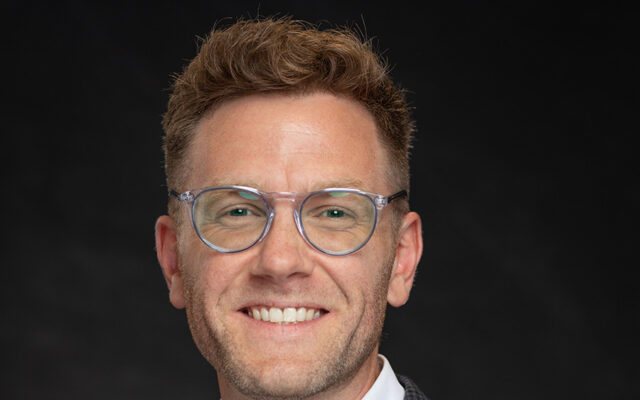
Cody Strecker
- Spencer 211
- [email protected]
“Be made acquainted with your own weakness, and so become strong in the only way that matters for a Christian, strong in the ability to acknowledge failure and seek aid, strong enough to confess in every sense of the word.”— Rowan Williams
Faculty Information
Additional Faculty Information for Cody Strecker
Education
Ph.D. in Religion (Theology and Ethics), Baylor University
M.T.S. (Early Christian Theology), Duke University
B.A. in Classics, Hillsdale College
Academic Specializations
Modern Theology
Early Christianity
St. Ephrem of Nisibis
Theology and Poetry
Pneumatology
Fellowships and Awards
Dissertation Research Grant, North American Patristics Society
Presidential Scholarship, Baylor University
Memberships
North American Patristics Society
American Academy of Religion
Society of Biblical Literature
Society of Anglican Theologians
Courses Taught
Western Theological Tradition
Historical Theology
Ancient Christian Poetics
Salvation
Christology
Neo-Orthodox Renaissance: Barth and Bonhoeffer in Nazi Germany
Pneumatology
Contemporary Constructive Theologies
Publications
“Silent Praise: Ephrem the Syrian’s Sentence Acrostic as Artistic Apophasis,” Modern Theology 42.2 (2026): 276-295.
“Interrogative Confessional Theology: Catechesis and the Theology Classroom,” in “A Symposium on Teaching Virtue: Interdisciplinary Perspectives on Pedagogy, Liturgy, and Moral Formation,” International Journal of Christianity and Education 23.2 (2019): 204-230.
“Life, Book of – Christianity,” in The Encyclopedia of the Bible and Its Reception, Vol 16. (Berlin: de Gruyter, 2018).
Presentations
“Ephrem’s Scribal Metaphysics in ‘Against Bardaisan’s Domnus’,” The 14th World Congress of Syriac Studies (Symposium Syriacum), Bucharest, Romania, August 3–7, 2026.
“Christ as Third? Ephrem and Trinitarian Orders,” North American Patristics Society Annual Meeting, Chicago, IL, May 21–23, 2026.
“Trinitarian Orders: In Favor of a Theological Bracketing of the Filioque,” Society of Anglican Theologians Annual Meeting, Boston, MA, November 21, 2025.
“Trinitarian Pneumatology and the [Bracketed] Filioque,” Reformation & Tradition Symposium, Hillsdale, MI, September 26–27, 2025.
“Theological Maturation in College Theology,” Ancient Evangelical Future Conference: Symposium on Anglican Theological Formation, Ambridge, PA, June 16–18, 2025.
“Fluid Boundaries, Mediating Walls: Reconsidering Ephrem’s anti-Eunomian Theology,” North American Patristics Society Annual Meeting, Chicago, IL, May 22–24, 2025.
“Vertical Texts: New Sentence Acrostics in Ephrem’s Madrāšē.” The Eighth North American Syriac Symposium, Syriac Worlds: Interactions, Exchanges, Contributions; Providence, Rhode Island, June 16-19, 2019.
“Lyric Order: Reimagining Creation’s Relation to Other Divine Actions ad extra.” American Academy of Religion Southwest Region Annual Meeting; Irving, Texas, March 8-10, 2019.
“Poetic God, Poetic Theology.” American Academy of Religion Annual Meeting; Denver, Colorado, November 17-20, 2018.
“Ephrem’s Acrostic Theology.” Society for Biblical Literature Annual Meeting; Denver, Colorado, November 17-20, 2018.
“Providence and the Poetry of Ephrem the Syrian,” Syriac Liturgy: History and Theology. Summer Institute of the Malankara Orthodox Syrian Church, Northeast American Diocese; Dalton, Pennsylvania, June 3-8, 2018.
“Lógos Theology vs. Theology of Melltha in the Works of Ephrem the Syrian.” Society for Biblical Literature Annual Meeting; Boston, Massachusetts, November 18, 2017.
“Academic Theology as Catechesis.” Baylor Symposium on Faith and Culture; Waco, Texas, October 27, 2016.
“Greek Pedagogues, but Jewish Teachers: Teaching and Learning Divine Truth in Pseudo-Justin’s Cohortatio ad Graecos.” North American Patristics Society Annual Meeting; Chicago, Illinois, May 28, 2016.
“Der Begriff: On the Usefulness of Hegel’s Dialectical Logic for Christian Theology.” Southwest Commission on Religious Studies Annual Meeting; Irving, Texas, March 12, 2016.
Biography
Hillsdale has always been committed to the study of the human being and the world, but also to their transcendent cause—in other words, to an understanding of liberal education as literary, scientific, and theological. For the tradition of theology that arises out of ancient Israel, to speak of the source of all things is to discern a face. God is a person, and personal, and has freely initiated a relationship with the world for the sake of the world. Theology is the study of that divine person. Its mode is to attend to the features of that relationship across time and throughout the world.
My theological interest is in focusing on the ways that the God of Israel calls for creative responses to the divine Word’s self-revelation. In images, stories, poetry, and music, in ethics, in worship, in little moments day to day, the shape of these responses can serve as witnesses to the God who has drawn near. In both teaching and research, I seek increased attunement to moments in the Christian tradition that have often been overlooked and, in the tradition of theological retrieval, to ask what possibilities of faithfulness they offer to us here and now. At present this means finding connections among contemporary reflections on the significance of lyric poetry, theologies of divine providence, and 1500-year-old texts in the Semitic language of Syriac.
After receiving Hillsdale’s liberal education as an undergraduate and before returning to teach at the College, I studied early Christian theology and modern theology and ethics at Duke Divinity School and Baylor University. I also spent a year studying at the University of Tübingen and the Reutlingen School of Theology in southwestern Germany. While there, I renewed my love of distance running and came to cherish daily life lived on foot with my wife, Mary, and our sons. Here in Hillsdale, our family delights in Saturday mornings at the farmers’ market, pretzel burgers at the local bowling alley, and backyard fires with friends.