Hillsdale in the Civil War
Written by Brennan Berryhill
The Detroit Advertiser and Tribune wrote about Hillsdale College in June of 1864, saying that “probably no college in the country is better represented in the Union Army… They have watered with their blood every battlefield of the Republic.”
It’s almost unthinkable to imagine a large chunk of our student body suddenly wrested away by bloody, brutal war, but that’s exactly what happened to Hillsdale College at the outbreak of the American Civil War. Some 530 students and graduates enlisted to serve in the Union army, carrying on the legacy of the Free Will Baptists, who founded Hillsdale College as staunch abolitionists and defenders of the Union. Now more than 150 years removed from the Civil War, 530 students would still represent about a third of our total undergraduate population. I can hardly comprehend the scale—every third person I see around campus suddenly gone, fighting for that “new birth of freedom” President Lincoln promised in his Gettysburg Address. It fills me with appreciation for the history of my college and the amazing courage that students here have had.
I sat down with Dr. Peter Jennings, associate professor of leadership studies and the Brouwer D. and Jane E. McIntyre Chair in Business Administration, to talk about Hillsdale College in the Civil War. Dr. Jennings has been conducting research about the College and the Civil War, and he teaches a class about the school’s involvement. My information comes from his wealth of knowledge about the topic. One thing Dr. Jennings stressed was that of those 530 students who fought in the war, none of them were drafted. Every single one volunteered. There were so many volunteers that some people were turned down because the state of Michigan had already filled its volunteer quota. A large portion of Hillsdale students fought on the front lines, including in the battle of Gettysburg. The 4th Michigan Volunteer Infantry, which had 23 Hillsdale students among its ranks, fought in “The Wheatfield” at Gettysburg, which had some of the fiercest fighting in the entire battle. It was dubbed a “harvest of death,” and only 55 of the 4th Infantry’s 342 men were not killed or badly wounded.
Hillsdale College served all over the country. Frederick Fowler, a College trustee, raised a group of men that would become G Company in the 2nd Michigan Cavalry. Twenty students served with him in the western theater of the war. Three officers from Hillsdale College led troops in the attack on Missionary Ridge to break through rebel defenses and make way for Sherman’s march to Atlanta. At the battle of Malvern Hill, a year before Gettysburg, Henry Magee of the 4th Michigan Infantry described the valor of Hillsdale students: “no college boy flinched… the college conscience, the student discipline and patriotic purpose was good for any emergency. Every college boy did his whole duty.” Hillsdale students were frontier boys who worked their way to an education and embodied the ideal of self-government, and they conducted themselves as such in the Army. Not only did they perform nobly on the battlefield, but they refrained from drinking, swearing, gambling, or brawling in the camps. Students and faculty who didn’t enlist served in the war effort back home through relief societies. Two such examples were the Sanitation Commission and Christian Commission. These organizations provided essential supplies and Bibles to troops.
The cost of the war was inconceivable. Of those 530 brave Hillsdale College soldiers, 100 never came home. A chunk of those that did, about another 140 soldiers, were crippled and maimed. Forty-five percent of the students that went to war became casualties. While the College continued on as before, there was a sense of profound loss. Dr. Jennings said that there was a strong veteran presence at the College after the war, and sometimes students would wear their Union uniform to class because that was the only pair of clothes they had to wear. Those who fought came back different people, having experienced enough trauma for a lifetime. It was during the wartime years that the school’s first alumni association was formed, and in 1885, there was a major reunion for students from the Civil War period. A sign was posted on the chapel that said “we honor the men who wore the blue,” and soldiers were commended for their duty during Decoration Day. This is the precursor to what we now know as Memorial Day.
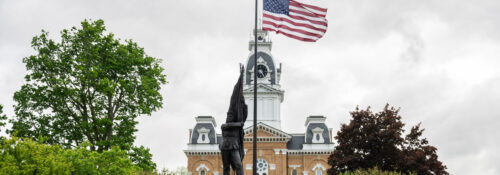
The Civil War Soldier monument between Kendall and Lane Halls was erected by the Alpha Kappa Phi literary society. Back then, literary societies were popular, fairly extravagant debating societies that were the center of social life for the students. There were no extracurriculars, so the societies were students’ main attachment to the College. Every Monday, they would sponsor essay contests, debates, oratory contests, and prizes. In 1895, the Alpha Kappa Phi society raised enough money to place the memorial on campus in honor of their fallen brother members. The 13 names you read on the monument are the 13 Alpha Kappa Phi members that were killed during the Civil War. However, the statue honors everyone that participated in the war.
In a speech about the monument, Dr. Jennings wrote that the statue memorialized “a spirit that defiantly, proudly, even cheerfully, accepts [its] duty.” Let us take the time to remember the brave Hillsdale College students who served in the Civil War and ask ourselves how we can emulate their example, leaving a heritage of which our predecessors would be proud.
 Brennan Berryhill, ’27, hails from Denver, Colorado, and when he isn’t writing or obsessively taking notes, you can find him playing trombone, debating, or nerding out over football.
Published in May 2024