
Monumental Storyteller: Sculptor Sarah Hempel Irani Hopes to be a Mentor to Others
Written by Doug Goodnough
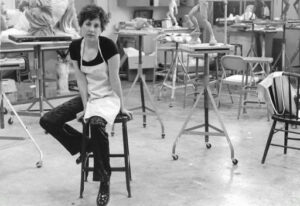 Sarah Hempel Irani, ’00, considers herself a monumental storyteller.
But she doesn’t use words to tell her stories. The figurative sculptor uses clay, bronze, and stone to fashion her complex three-dimensional narratives out of her studio in the artsy community of Frederick, Maryland.
Now an acclaimed commissioned artist, Irani said her story in art started at a very young age.
“The moment I could hold a crayon, that’s what I did,” she said. “I was always very curious, and I think that curiosity is a hallmark of creativity.”
A talented high school artist, she thought she wanted to study art at the School of the Art Institute of Chicago.
“It was the most amazing place in the world to me,” said Hempel Irani, who had visited the museum many times as a child. “We went to the school, and there was a sculpture professor teaching a workshop. He came down the hall and asked me, ‘Are you lost?’ I told him I wanted to study art. He said, ‘What are you, like 17 or 18? You don’t know anything about anything. Go to a liberal arts college and study the Great Books and read something and travel and come back after you have something to say.’ And I thought that sounded like good advice.”
The librarian at her middle school suggested that Hempel Irani look at Hillsdale. That librarian happened to be the mother of Rich Péwé, ’88, who at the time was working in Admissions at Hillsdale. Hempel Irani decided to visit Hillsdale and met art faculty members Anthony Frudakis and Sam Knecht.
“When I met them, I knew this was the school I wanted to go to,” she said.
However, she still wasn’t quite sure what type of artist she wanted to be.
“I went to Hillsdale thinking I wanted to be a medical textbook illustrator,” Hempel Irani said. “I love science. I love observing the natural world.”
A sculpture class with Frudakis during her freshman year was a formative experience.
“I had always been good at art. It came naturally to me,” she said. “But I had encountered something that was very difficult, and I really struggled in that class. It was harder than any other kind of art I had done, and I wasn’t going to let it beat me.”
Her artistic talent was such that Hillsdale Academy commissioned her to sculpt a statue of a boy and a girl reading a book. She stayed in Hillsdale over the summer to work on the “grueling” project.
“I sculpted them separately and then put them together,” she said of the process, which included a cast in hydrocal plaster with a faux bronze finish. “It was amazing and terrible at the same time. I didn’t have all the skills, but I had plenty of enthusiasm. Somehow, I pulled it off. I had a sense that this is what I do now.”
She said the “sense of exploration” Frudakis created in his classes also convinced her that sculpture was her future.
“I learned from him not to hold on too preciously,” Hempel Irani said of the creative process. “If a nose wasn’t working, it was fine to chop it off and start again. He said, ‘You’ve already done it once. The next thing you do could be better.’ He really taught me a sense of learning from mistakes and making adjustments.”
That’s advice she still heeds. In fact, one of her first commissioned projects after graduation was a sculpture of St. Joseph for a Catholic church in Potomac, Maryland.
“One of the guys on the committee said, ‘I don’t like his hair,’” Hempel Irani remembered. “I went home and was so mad. He doesn’t like his hair? Are you kidding me? So I took a mallet to his hair and started pounding on it. I moved the hair so that it looked like there was wind. It created a sense that the Holy Spirit had come and given the sculpture a lot of movement. And it made the sculpture so much better.”
It was through this experience that she learned the collaborative aspect of her work is the most rewarding.
When the prestigious Frederick Art Club wanted to honor Frederick native and women’s fashion icon Claire McCardell, Hempel Irani quickly became involved in the process. What started as potentially a plaque and a small sculpture eventually turned into a 7-foot, 6-inch bronze statue that Hempel Irani was commissioned to create.
“People were so excited about it. The club got a tremendous amount of support and raised a lot of money in a short period of time,” she said.
After an initial design and small sculpture model, Hempel Irani began the daunting task of bringing the piece to life. Standing a diminutive 5 feet, 2 inches, Irani said the work was physically demanding as she used her entire body to craft the finished product.
She said the COVID-19 pandemic complicated the work.
“On one hand, I had a lot of time,” Hempel Irani said. “On the other hand, it was a really stressful time. I had a middle school-age daughter, and we were doing school at home.”
She said she wanted every element of the piece to be perfect.
“I redid her feet probably 30 times,” Hempel Irani said.
After some additional feedback from the committee, which she initially “bristled” at, she again remembered the advice from her mentor and took it to heart.
“It made the work so much better,” she said.
In October 2021, the statue was unveiled during a public ceremony in Frederick’s Carroll Creek Park.
“That was an incredibly collaborative effort,” said Hempel Irani, who hopes that statues of more women of accomplishment will be featured in public places. “It was a community project, and I love that.”
Hempel Irani had to face yet another challenge, this time a personal one. She was diagnosed with cancer several years ago, and working through that process changed her perspective. Thankfully, she is now cancer-free.
“I am a cancer survivor,” she said. “You carry it with you. Even though I no longer have cancer, you don’t get to go back to being the person you were, which in a lot of ways is good. That’s an important part of my journey as a person.”
That journey involves some new experiences, including a five-week art residency in France in 2023.
“It was amazing and sort of a reset,” said Hempel Irani, who has also started to incorporate some technology into her creative process. “I could just focus on art, and that was really an incredible and restorative experience.”
She recently announced she is running for a spot on Frederick’s city council.
“I’m pretty excited about that,” Hempel Irani said of her venture into local politics. “We like to think of ourselves as an artsy town here in Frederick, but we don’t necessarily have anybody representing the arts in city hall. So, I’m going to have a go at it.”
She remains in close contact with classmate Grace Ellis Barber, ’00, who received the same art scholarship as Irani when they enrolled at Hillsdale. And she said she enjoys traveling with her husband and daughter, as well as gardening, listening to opera music, and watching all the episodes of the Star Trek television series.
Hempel Irani said her work at Hempel Studios slowed a bit after the pandemic, so she also started teaching art at nearby Frederick Community College. She said continuing the mentorship legacy of Frudakis and Knecht is very important to her.
“I have an ethos that I live by: I want to use my gifts and talents to serve others and to make the world better,” she said. “I hope that as I get older and more experienced, I can be the Sam (Knecht) and Tony (Frudakis) to the next generation.”
*The banner image of the Claire McCardell sculpture was taken by photographer Michael DeMattia.

Doug Goodnough, ’90, is Hillsdale’s senior director of Alumni Marketing. He enjoys connecting with fellow alumni in new and wonderful ways.
Published in March 2025