Economics on the Weekends
Written by Lauren Smyth
 Give an economist some Monopoly money, and she’ll build a hotel—or 12.
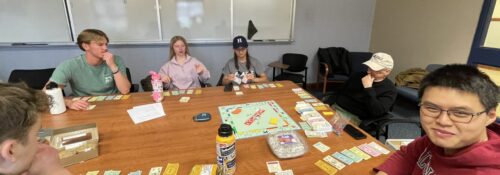
It’s just before dark on a Saturday night. In Lane Hall, six economics students have (reluctantly) set aside their homework and gathered to test their moneymaking skills. Snacks pile up like offerings around the Monopoly board. Soda cans are cracked open. I grab the off-brand “Yummy Chow,” peanut butter-covered cereal that’s my favorite, and pass it around.
Dr. Charles Steele, associate professor of economics, presides at the head of the table. He’s here to make sure the play stays fair and to take his shot at the grand prize—a T-shirt signed by the economics faculty and a free dinner at the next political economy club event.
The Economics Department is statistically more competitive than other departments on campus, according to our own research. We play fair, but we don’t play nice. We’re all smiles as we take each other’s money.
We each roll a die to figure out who starts. No one can make sense of the results, so we hand the dice to Dr. Steele. He rolls a four and promptly lands on income tax. Laughter from all. So far, the game is just like real life.
With seven players, it doesn’t take long before all the properties are owned. We round the board a few more times, and then, realizing we’re not getting anywhere, we call a halt. This is where the real rules come into play—the moment we’ve all been waiting for.
“I’ll give you four hundred dollars for your railroad,” someone says. Someone else, louder: “Five hundred!” Someone who has never played the game before: “Does anyone want to buy my entire monopoly?” The room echoes as, like Wall Street traders, we make frantic offers and negotiations. It’s not about money anymore. Whoever is the loudest wins the deal.
I want rent immunity. I have to give up two monopolies to get it, but I end up with all four railroads and a hoarse throat from shouting bids. Properties and cash change hands faster than anyone can track until at last we subside into our chairs, content with our purchases and ready to do battle again.
A few minutes later, we lose our first player to the ravages of capitalism. He wanders over to the whiteboard and starts scribbling equations. Can all of microeconomics be condensed to a Lagrangian optimization problem? There are two math majors in the room who know what’s going on. The rest of us try to laugh in the right places.
The solution: X = +/- 42. No one knows what this means.
After an hour, it’s down to me, Dr. Steele, and political economy club president Brian Shia, ’27. I have rent immunity from both. I have no way of enforcing this except by loudly calling on other players at the table to witness the deal, but it seems to work. Public opinion is on my side. I forgive rent in exchange for mints. Eventually, I collect more mints than I can eat, and the game ends.
Dr. Michael Clark, whose office is three doors down from Dr. Steele’s, once said that economics is more than just a major: “It’s Team Econ!” We’re proof of that community-building spirit as we clean up empty chip bags, sort the Monopoly money, and tease the whiteboard calculator for turning a social gathering into a study session. Students at Hillsdale are competitive, but not with each other. Friendships between classmates push students to be the best versions of themselves and help them have fun along the way.
That’s the best kind of learning—the kind that’s done for love of the subject and for the love of learning itself.
 Lauren Smyth, ’25, is an economics major and journalism minor. Outside of starting arguments in philosophy class, she enjoys curling up on a bench outdoors (sun, rain, or snow) to write novels or articles for her blog, www.laurensmythbooks.com.
Published in May 2025