Four “Brawny Lads” and a Boat: The Four Oarsmen Bring Hillsdale National Acclaim
Written by Monica VanDerWeide, ’95
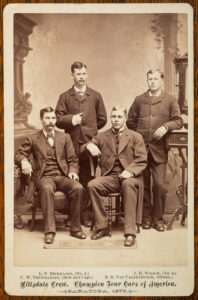 They had no coach. They had no formal training. They had no experience. Yet in 1879, four young men from Hillsdale decided to form the Hillsdale Rowing Club and pursue the gentlemen’s sport of rowing. These four, three of whom had attended Hillsdale College in the early 1870s, comprised the rowing team that would catapult Hillsdale into the national spotlight with three National American Amateur Rowing Championships titles.
Friends and local residents Clarence W. Terwilliger, Lewis F. Beckhardt, T.D. Wilson, and Esbon B. “Eb” Van Valkenburgh worked as clerks and firemen in Hillsdale. In fact, Terwilliger, who was team captain, was one of the firemen who responded to the devastating campus fire in March 1874 that destroyed most of the original college building. The four also played baseball together in the Hillsdale Base Ball Club, so they clearly had athleticism. But, as Terwilliger recalled in a speech decades later to the local Rotary Club, preparing for rowing competition while working full time was no small feat.
“…this exercise was all taken after 9 o’clock or half-past 9 o’clock in the evening, when we used to get out of the stores in those days, and we were all clerks. We used to get up to the stores along about 7 o’clock [in the morning] or a little earlier, and open up the store and get everything in readiness for business. We kept the stores open until 9 o’clock, and after that would go down and spend about an hour or an hour-and-a-half in good hard work.”
That “good hard work” consisted of “lighter calisthenic exercises as well as the heavier ones,” including work with dumbbells, Indian clubs, parallel bars, single bars, rings, tumbling, wresting, and boxing, in addition to running. “We were pretty handy at all of those; there wasn’t much of anything but what we could handle,” Terwilliger recounted. The crew practiced in their boat on Baw Beese Lake, and with only a few months of preparation under their belts, competed in their first event—the Northwestern Regatta in Toledo, Ohio.
The Hillsdales, as they were known, handily won the regatta. In July 1879, they competed for their first National American Amateur Rowing Championship (NAARC) at the Saratoga Regatta. Again, the four oarsmen achieved a resounding victory with the best time on record: 8:32 for the 1.5-mile contest. Upon their return to Hillsdale, the quartet received a hero’s welcome. Flags bearing the crew’s colors of blue and white adorned the streets of downtown Hillsdale. The celebration on July 14, 1879, included a parade and a day of festivities with bands, fireworks, and a reception at Underwood’s Opera House. Will Carleton, an 1869 alumnus and nationally known poet, first read his poem “Our Four in a Row.”
The success of this novice crew ruffled the feathers of more established rowing teams. Following the Northwestern Regatta, one of the losing teams, the Undines, got an idea to race the Hillsdales again, claiming that their crew had been too tired from a previous race when competing at the Northwestern: “If we had been as fresh as the Hillsdale crew, we could have won that race; now, if we can go up to Hillsdale and we can defeat that Hillsdale crew, we will have the honors of defeating the champions of the United States and Canada.”
That set in motion a plan to hold a regatta right in Hillsdale in August 1879. Other teams eagerly jumped at the opportunity to try to beat the Hillsdales, but once again, Terwilliger and his men prevailed. They continued undefeated for the next three years as they traveled the country, competing in regattas in New Orleans, Washington, D.C., Philadelphia, Moline, and other competitions closer to home and winning three NAARC titles. Their success grabbed the attention of the media, with the New Orleans Picayune calling the crew “the brawny lads from Michigan.” Following the crew’s Saratoga victory, the New York World published this humorous observation: “Perhaps it will be necessary to inform our readers that Hillsdale is a town, village, or something, of Michigan. It must be, at all events, on water. One would be inclined to infer from the performance of four of its inhabitants this morning, that it is a sort of small Venice.”
In 1882, the NAARC Executive Committee approached the Hillsdales about going over to England to compete. As Terwilliger recounted, his crew was hesitant to go based on the negative experiences that other American teams had had competing across the pond. But the committee convinced the oarsmen to go, and on June 12, 1882, Terwilliger, Beckhardt, Wilson, Van Valkenburgh, and Homer Mead, an alternate rower, sailed out of Philadelphia for England on the Pennsylvania steamer of the American Steamship Line. The Hillsdales weathered seasickness, a strong storm, and boredom on the 12-day voyage, arriving in London on June 23, 1882.
The Hillsdales were entered in multiple regattas in England for that summer, but they were greeted with controversy upon their arrival. The executive committee of England’s Amateur Rowing Association (ARA) informed the Hillsdales that “it will be impossible for any of our oarsmen to meet the Hillsdale crew as a contestant, on penalty of losing our standing as amateur oarsmen of England.” The executive committee members were convinced that the Hillsdales were professional oarsmen due to their physique, their rowing style, and their success, even though the Hillsdale crew had provided verification of their amateur status. While Hillsdale was denied the opportunity to compete in the prestigious Henley Regatta, the committee of the Great Marlow Regatta, in a conciliatory gesture, agreed to let just one team compete against the Hillsdales, who continued their winning streak with a handy defeat of the Englishmen.
A flurry of transcontinental letter writing ensued as the Hillsdales tried to appeal the decision of the ARA committee. News outlets and rowing associations on both sides of the pond, angered by the injustice toward the Hillsdales, expressed their frustration. “The London Sportsman says it is utterly astonished at the action of the Committee of the Amateur Rowing Association in passing the resolution touching the status of the Hillsdale crew,” the New York Herald wrote. “The popularity of their [the Hillsdales] success is a proof that the self-constituted authority known as the Amateur Rowing Association, which presumed to question the amateur qualifications of the crew, does not represent the feelings and wishes of all the rowing men in England.” L.E. Saunier of the National Association of Amateur Oarsmen wrote a letter to the crew, encouraging them not to be disheartened by the “insulting and cowardly treatment” by the committee.
Nonetheless, Terwilliger issued a challenge to the Thames Rowing Club, the champion rowers of the Thames River, to compete against Hillsdale. At the urging of friends back at home, he also issued a general challenge to any English crew to compete against them. When the Thames crew declined, the Hillsdales made plans to do some European traveling before securing their tickets back to America. A disappointed Terwilliger wrote to his girlfriend (and later wife) Calla that they would likely be coming home much earlier than anticipated due to the unwillingness of any of the English teams to compete with them.
But then, days later, the Thames club, along with representatives from the London, Cambridge, Oxford, and other English rowing clubs, surprised Terwilliger at his hotel one evening with some news—they wanted to compete against Hillsdale. After considerable discussion, a date was set and preparations got under way.
The course on the Thames in London, with its twists and turns, strong tide, and an abundance of boats and barges sharing the water with the rowers, proved to be unlike anything the Hillsdales had rowed before. “I can’t keep the boat pointed straight anywhere,” Terwilliger lamented during practice. Nonetheless, during the race, the Hillsdales managed to stay ahead of the Thames crew for about the first two miles. Then, the force of the wake from a vessel ahead of the Hillsdales hit their boat so strongly that Terwilliger’s seat broke. Undeterred, the crew kept rowing, still maintaining a lead, when near the four-mile mark, the seat slipped off completely and fell to the bottom of the boat. The crew stopped rowing briefly and the Thames crew surpassed them. But the Hillsdales persevered, gaining ground and almost catching up, but ultimately falling just short of the victory. That day, September 15, 1882, marked their first defeat since the spring of 1879.
In spite of the disappointment, the Hillsdales returned home once again to great fanfare and far-reaching respect. In fact, when President Theodore Roosevelt made a visit to Hillsdale in 1907, he noted “the great impression made upon me” by the oarsmen 25 years before.
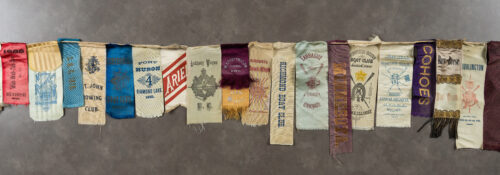
While Hillsdale rowing teams have come and gone through the decades, no other team has matched the success of the Hillsdales. In the years following the oarsmen’s championship streak, Hillsdale College adopted blue and white as its official colors, a nod to the colors of the hometown crew. And the story is preserved through boxes of memorabilia, including flags, ribbons, crew uniforms, photos, and a treasure trove of letters to and from Clarence Terwilliger during the 1870s and 1880s that were found in the Delta Tau Delta fraternity house and later donated to Mossey Library. Eventually, these items will be scanned to the library’s digital archive (lib.hillsdale.edu) for anyone to learn about the fascinating feats of Hillsdale’s four “brawny lads.”
Editor’s note: Thank you to the Hillsdale County Historical Society and Hillsdale College Archivist Lori Curtis for their assistance.
 Monica VanDerWeide is Director of Marketing Content for Hillsdale College. She graduated from Hillsdale in 1995 with a degree in English and German.
Reposted from the spring 2024 issue of Arete.