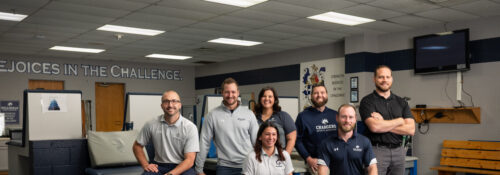
Far From Basic Training: Sports Medicine and Performance Team Recognized as Conference’s Best
Written by Doug Goodnough
Tyler Cortright believes the phrase “Hillsdale College doesn’t teach students what to think, it teaches them how to think” also applies to the care of its student-athletes.
As the College’s assistant athletic director for Sports Medicine and Performance, he is convinced educating Hillsdale’s student-athletes is the key to preventing injuries and optimizing performance.
“What we do well is teaching,” said Cortright, who started at the College as an athletic trainer in 2016 before being promoted to his current position. “We only see our student-athletes about 8-20 hours per week, but we can educate them about the many things they can do outside of their required time at practice and in the weight room to make sure they are well prepared.”
Cortright leads a team that includes head trainer Dan Hudson, and athletic trainers Lynne Neukom, ’91, Mikayla Kemp, Kevin Kosiorek, and Jordyn Dubina, who oversee care for student-athletes in all 14 of Hillsdale’s varsity sports. Head Strength and Conditioning Coach Mitchell Schoenborn and Medical Director Kam Mueller are also part of the team that keeps the Chargers in peak physical condition.
And that team does its job very well. In 2023-24, Hillsdale’s Sports Medicine and Performance Department was named the Great Midwest Athletic Conference Athletic Training Staff of the Year. It was the second time Hillsdale was recognized by its peers with the honor since 2019. The award criteria included hospitality toward visitors; host preparedness with supplies, equipment, and services for visitors; care for injured student-athletes from visiting teams; and overall staff preparedness for emergency situations.
“We’re really grateful for winning that award. There’s a lot of different indicators of success with our team,” Cortright said. “Number one is, what kind of impact are we having on these kids? Number two is when kids have issues on campus, they know that they can trust in us on developing an adequate plan of care.”
Cortright said former Athletic Director Don Brubacher and current Athletic Director John Tharp have been supportive in increasing the size of the training staff, which is crucial to building continuity with the team. When Cortright arrived in 2016, the staff consisted of just him and Neukom. The Chargers now have six full-time trainers.
“He saw the importance of work/life balance,” Cortright said of Brubacher, who promoted him to his current role in 2018. “You want to keep good athletic trainers on a college campus. If you don’t create a good schedule, then you’re not going to keep people very long.”
Cortright, who interned with the NFL’s Green Bay Packers for two years while a student at Hope College, knows burnout. Before coming to Hillsdale, he worked as a trainer and strength and conditioning coach in the Jackson and Lansing area for several years, working with multiple high schools and colleges. In 2014, he had to step away because of what he called “burnout.” Now, with a wife and two children under the age of 5 at home, he said the team approach Hillsdale provides strikes the necessary balance.
“I tell my wife and kids our schedules are at the mercy of a team’s schedule,” he said. “There’s a lot of things that we can’t control. But what we do really well as a team is help each other out. I like to think our staff is genuinely happy.”
Cortright said having a diversity of expertise on his staff is critical to the operation. Because of his background in both training and strength and conditioning, he can help identify potential injuries before they happen just by watching the movements of student-athletes.
“We have other athletic trainers who are good with their hands,” Cortright said. “Dan Hudson is great with shoulder rehabilitation and shoulder evaluation injuries. He’s worked in baseball for a number of years.”
And whether it’s dealing with student-athletes, parents, or coaches, there is one common denominator: communication.
“Communication is extremely important,” he said. “I always tell our athletic trainers, no matter who you’re working with, whether it’s a student-athlete, a coach, or a parent, try to empathize with the position that they’re in. If you’re not doing that, it’s hard to communicate in the right way.”
Sometimes the training staff needs to work on the mental and psychological side as much as the physical with recovering student-athletes.
“What I’ve noticed over the years working in the college setting is that you are kind of a mom or dad away from home,” Cortright said. “Students may have something going on in class or in their personal lives. It’s not just a knee injury or shoulder injury. Sometimes you’re doing a rehab session with them and a lot of other things come out.”
He said his team’s goal is to look out for a student-athlete’s best interest, both now and in the future.
“We want to help that student-athlete get back on the field to help the team,” he said. “I don’t want to see athletes leave our Athletic Department at the end of their careers and they can’t walk well, or they are headed down the road of poor health. We want to educate and guide them so when they leave here, they can lead a happy, healthy life with their families.”
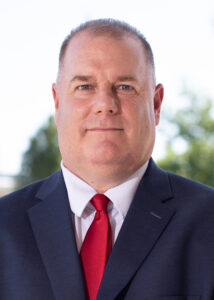
Doug Goodnough, ’90, is Hillsdale’s senior director of Alumni Marketing. He enjoys connecting with fellow alumni in new and wonderful ways.
Reposted from the spring 2025 issue of Arete.