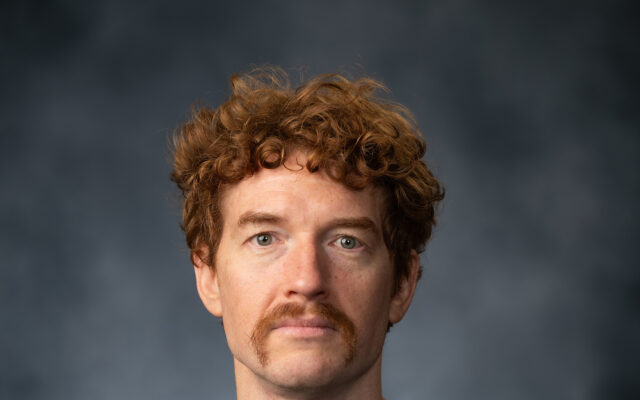
Oliver Serang
- Dow Science 109
- [email protected]
The above personal links are controlled by the individual and are not any form of representation of statement by Hillsdale College. They are provided as a convenience and views expressed on the sites may not reflect the views or opinions of the College.
“I’d like France to have two armies: one for display with lovely guns, tanks, little soldiers, staffs, distinguished and doddering Generals, and dear little regimental officers who would be deeply concerned over their General’s bowel movements or their Colonel’s piles, an army that would be shown for a modest fee on every fairground in the country. The other would be the real one, composed entirely of young enthusiasts in camouflage uniforms, who would not be put on display, but from whom impossible efforts would be demanded and to whom all sorts of tricks would be taught. That’s the army in which I should like to fight.”— Jean Lartéguy (translation by Xan Fielding)
Faculty Information
Additional Faculty Information for Oliver Serang
Education
Research Fellow, Harvard Medical School and Boston Children’s Hospital, 2013
Ph.D., University of Washington, 2011
B.S., North Carolina State University, 2006
Biography
I found computer science just like everybody else. I was in search of automation and efficiency, a recipe to simplify a square root on my homework or to choose a plumbing layout requiring the least digging below the frost line. Computer science was the study of how things can be done.
What I found was far better: an ever-advancing frontier filled with tricks to accomplish the apparently impossible. Who knew that, contrary to what we had been taught in grade school, you could multiply numbers without introducing every pair of digits? That you could compute the median without sorting? And further, past the swords pulled from stones, I was surprised by the limits on what can be accomplished, limits as inflexible as the speed of light. Who knew that the game Guess Who? cannot be reliably won in fewer than five turns? And further still, that we can prove that some true things can never be proved?
My career path has allowed me to visit and admire problems from engineering, biology, chemistry, and finance. It is satisfying to solve problems, to watch a puzzle befriend you and give way. But outside of the pure meritocracy of speed, immersion in these topics has given me some hope in that great, private struggle of mankind: though “the cradle rocks above the abyss,” something beyond the common sense of our mortality may yet be found among those things that we’ve incorrectly judged impossible or that we can simply never know.
I’d like for students to take as much as I have from the craft of problem solving and coding. Greater than prosperity or the chance to prove ourselves, it lights the path toward an antidote to despair in a world where “all is vanity.” And what is more American than building something on the frontier while considering our place before God?