How Do I Love English?
Written by Faith Senne
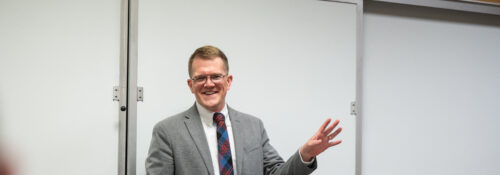
On the first day of my sophomore year, I sat in the front row of the classroom for my second-to-last class. Excitement danced up and down my spine. Around me, friends conversed and strangers introduced themselves to each other. At the bottom of the hour, Dr. Benedict Whalen began the first class of Great Books in the British and American Traditions (Great Books II).
When I first registered for Great Books II, I was interested in pursuing an English major or minor because of Dr. Justin Jackson’s Great Books in the Western Tradition (Great Books I), but I didn’t think I would end up doing it.
Dr. Whalen’s first lecture contained all of the housekeeping items you would expect to find at the beginning of a college class: the syllabus, the academic policy, and an overview of what we would be reading. But Dr. Whalen’s Great Books II class included something that my other first lectures did not: poetry.
Handing us sheets of Robert Frost’s “Nature’s First Green is Gold,” Dr. Whalen explained that we would memorize poetry throughout the semester. As we read and analyzed Frost’s poem, I gradually realized the depth and truth of it—how we as humans are thoroughly blessed, and because we are thoroughly blessed, we take so much for granted, such as nature.
As I write in Heaven (the main floor of the Mossey Library), I can see the trees outside in their green glory. The leaves are gold in the sunlight, as Frosts points out. But it is a different kind of gold he is thinking of. When one thinks of leaves being gold, they no doubt think of autumn settling in and the coming frost. But this is precisely why, for Robert Frost, we mustn’t take nature for granted: after a long winter, when the first green peeks through the thawing ground, we breathe a sigh of relief. At last, we say, we have made it through the storm, and nature’s first green at this time is gold. But only at this time. Sadly, we become desensitized to nature’s beauty, and the green we rejoiced in becomes an afterthought.
Dr. Whalen’s Great Books II also helped me realize we mustn’t take our present circumstances for granted. I Thessalonians 5:16-18 states, “Rejoice always, pray continually, give thanks in all circumstances; for this is God’s will for you in Christ Jesus.” And so, although I had no intention of continuing my study of English after the two Great Books courses, Dr. Whalen changed my mind. In fact, he made me fall in love with poetry so deeply that I am now minoring in English. I committed my 2025 summer to studying at Oxford University, and I am taking Dr. Stephen Smith’s Shakespeare’s politics and poetry class. Thus, I owe Dr. Whalen credit for making me love English (and my two cents’ worth of philosophical musings that resulted from it).
Frost states that nothing gold can stay. Sadly, this is true for a lot of people, but it doesn’t have to be. As students, if we slow down, take a deep breath, and do something that will bring us joy (baking, sketching, laughing with friends, or memorizing poetry), then the gold will stay. For me, adding an English minor brings me joy. I will be busier than ever, but because this is something I want to do, the gold will stay for me, too. And so, I thank you, Dr. Whalen.
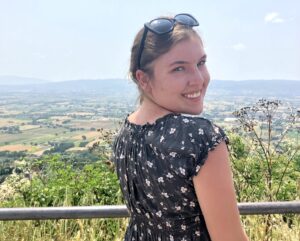 Trading her southern California natural habitat for a parka and snow boots, Faith Senne, ’27, is a double major in history and German with a minor in English. When she isn’t writing a paper about a niche topic like prudence in Shakespeare’s tragedies, you can find her in line for coffee at Penny’s, practicing lead changes on horseback, or practicing her violin.
Published in October 2025