Libraries, Towers, and Unforgettable Hours: The Oxford Study-Abroad Experience
Written by Megan Li and Faith Senne
Megan’s experience
When I got off of the double-decker bus in Oxford, England, last summer, it was raining—an appropriate weather condition for my first day in the stereotypically gloomy country. As Google Maps guided me to the Oxford Study Abroad Programme office, excitement began to replace my initial nerves. I was in England for the first time, and I was getting a taste of school at one of the oldest universities in the world. Everything was going to be just dandy.
The programme coordinators wasted no time getting us students acclimated to English culture: the first stop my orientation group made was the King’s Arms pub, the oldest pub in Oxford. Pubs easily became one of my fondest memories of England. They are hubs of warmth and community, each with their own unique atmosphere, where people grow in friendship and form new ones. My friends and I paid visits to the retro, hidden gem Turf Tavern, as well as the iconic Lamb and Flag, where the Inklings literary group used to meet.
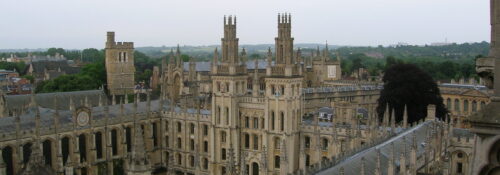
Over the next few days of orientation, the programme coordinators led us on a tour of Oxford, where they casually pointed out beheading locations and buildings that have stood long before America ever existed. We strolled the cobbled roads through the city’s stunning architectural landscape, gaping up at the soaring towers, intricate carvings, and Gothic domes that wait behind every corner. The tour guide pointed out the door on St. Mary’s Passage that supposedly inspired C.S. Lewis’s The Lion, the Witch, and the Wardrobe, took us down bustling Cornmarket Street and Broad Street, and gave us an overview of the university’s 36 colleges and more than 100 libraries.
It was all too easy to forget in Oxford that I was there as a student, not a carefree tourist. I was taking a course on comparative economics, which proved quite challenging, but fruitfully so. Each week, I wrote a 10-page paper on a different country’s economy, using a provided reading list of sources found within the Bodleian Libraries—the university’s impressive research library holding over 13 million printed items and countless more digital ones. Once a week, I went into my professor’s office at Pembroke College, where we discussed for an hour what I had written. I learned I knew very little about economics. This was the Oxford tutorial.
Over the next six weeks, I fell into something of a routine, which I learned is something many Oxford students come to adopt with their independent studies. In the mornings, I would camp out in one of Oxford’s gorgeous libraries (my personal favorite was the Radcliffe Camera) to research and write my paper. The wealth of knowledge in each Oxford library, hidden both in the abundance of books and in the legacy of great men and women that had passed through the university, was like a tangible presence in the room. There is nothing that motivates you more than studying in a library straight out of Hogwarts, surrounded by silent students with heads bowed over books and laptops.
After a few hours of work, I would get lunch with a friend—we quickly found our staples at sandwich shops. In the afternoons, I camped out at a cozy coffee shop (Oxford was chock-full of these) where an overpriced latte would keep my brain moving despite the post-lunch slump. I tried to keep my evenings free to do some exploring or read a fun book, but on days that weren’t so productive, I would often work in my room at “the flat” (it was actually a house, but we used that phrase to feel more British).
Despite the workload, I managed to fit in many fun excursions with friends. The programme took us on day trips to Cambridge University, London, and Bath. My friend and I took the bus to Blenheim Palace, the birthplace of Winston Churchill, which we unanimously agreed was the highlight of our time in England. I tried beans on toast (it was delicious!), went punting (which proved harder than it looked), saw horses in Port Meadow, and wandered many streets and shops.
Before I knew it, the six weeks were over. My brain was exploding with all the economic knowledge I had read but did not process, I had started thinking in a British accent, and my bank account was in the negatives. But spending time at Oxford University renewed my belief in the importance of education and the richness that it brings to human life. It opened my eyes to a new perspective on economics, the invaluable community a university is capable of forming, and the breathtaking beauty of Oxford. The city’s busy streets, teeming with life and history, and its quiet countryside that brings peace to the soul, remain fondly in my memory.
Faith’s experience
This past summer, I studied British poetry abroad in England with the Oxford Study Abroad Programme. After planning the trip with my best friend Ava-Marie Papillon, ’26, we crossed the pond to begin our adventure. We visited London first, exploring the Sherlock Holmes Museum, trying on crazy clothes at Selfridges, and visiting Big Ben at 11:30 p.m. after watching Mission Impossible: Final Reckoning, but then it was time for us to begin our studies at England’s oldest university.
Oxford University was founded (unofficially) in 1096. As I first walked the grounds of New College, the college into which I was initiated, I imagined my favorite authors and poets studying there. Greats like Evelyn Waugh, Seamus Heaney, and Percy Shelley studied at Oxford. What better place to study, therefore, than at Oxford?
A few days later, I attended my first tutorial, and to it I brought my first commentary on Wordsworth’s “Lines Composed a Few Miles above Tintern Abbey.” As I read through the poem, I understood what Wordsworth had been attempting to put into words. Five years after his first visit, Wordsworth returned to the Wye Valley in Wales for a visit, where Tintern Abbey is. The Abbey itself is in ruins, but it remains a refuge for Wordsworth all the same. After an intense semester at Hillsdale, Oxford was my Wye Valley. I studied under the guidance of erudite Oxford faculty (and received credit for it at Hillsdale!), and my tutorials reminded me why I love learning in the first place. Not only is learning true, good, and beautiful and an end to human existence since it glorifies God, but it also fills your soul with love and appreciation for the things around you. I realized this through my studies at Oxford, and Wordsworth realized it through his return to Tintern Abbey.
Just as I’m sure Wordsworth was sorry to leave Tintern Abbey, I was sorry to leave Oxford. I had come to know the city very well. I knew where to go without needing a GPS, I knew where the best restaurants were, I knew where to find a certain meadow with horses you can just walk up to and pet, and I knew why I loved it so much: it was my Tintern Abbey, my “Lake Isle of Innisfree” (another poem I studied while there).
When we left Oxford, we went back to London to see more sights such as Charles Dickens’ house, John Keats’ house, Abbey Road from The Beatles, and the HMS Belfast, which saw action on D-Day. We took one of the Fab Four taxi tours of sites from The Beatles, saw the RMS Lusitania’s anchor, and visited the Royal Navy’s “Western Approaches” from the Battle of the Atlantic.
But my pilgrimage ended all too soon, and I found myself on a British Airways flight back to the U.S. I carried with me the lessons and memories of the trip: the wonderful experiences I had with Ava, the wisdom I gleaned from my tutor, and the passion I developed from the poets.
Published in March 2026