
New Marching Orders: Dr. Fredericks Creates a World War I Literature Class during Sabbatical
Written by Brennan Berryhill
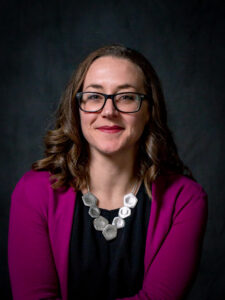 When we’re children, we assume that our teachers live at school. That’s what makes it so traumatizing to run into them at the grocery store and realize they are normal people. But we “enlightened” college students can fall into the same trap of assuming that our professors simply exist to teach class, even though that only covers a portion of their work at Hillsdale College. It wasn’t until I joined an English course on World War I British Literature taught by Dr. Elizabeth Fredericks, associate professor of English, who explained that she had developed the class during her time on sabbatical, that I gave thought to the “secret lives” of college professors. I asked Dr. Fredericks about her sabbatical during the spring of 2025, and she explained how she used the time to expand her own learning and create new curriculum.
Dr. Fredericks’s primary research focus during her sabbatical was a project on “depictions of motherhood in contemporary Irish women’s poetry.” She looked for recent poetic depictions of painful moments in Irish women’s history, specifically the combed-over abuse in the Magdalene Laundries and the Mother and Baby Homes. Dr. Fredericks read through dozens of poetry collections and presented her work on the Mother and Baby Homes at a conference in February 2025. A secondary research focus of hers was drafting an article based on work she had completed in Dublin in 2024 on poet Patrick Kavanagh.
Her sabbatical routine settled into letting the dog out, making coffee, and writing for a few hours in the morning (something Dr. Fredericks expressed surprise about, since she had largely been an evening writer in graduate school), before walking the dog and reading Irish poets or World War I writers. She said that one of her favorite parts of the time away from teaching was “the long, unbroken stretches of time to read and really sink into a huge number of texts, something that I can only do in more piecemeal fragments during the semester.” While most of her time was spent at home, Dr. Frederick’s big sabbatical adventure was a road trip to California to see family and visit old friends along the way. Why would you spend January in Michigan when you could be in California, she asked—especially if you’re reading bleak World War I memoirs?
The idea for the World War I British Literature class had been fomenting for a while. Dr. Fredericks loved teaching on World War I poets like Siegfried Sassoon and Wilfred Owen during her Victorian and Modern British Literature class. A class on World War I literature drew together many of her major interests, including the Irish revolutionary decade, British suffragettes, and literary modernism. “This was a complex class to develop,” Dr. Fredericks said, “particularly since I knew that I wanted it to be multi-genre (not just poetry or prose fiction), and also that I wanted to include windows into experiences that are less frequently discussed, such as the Irish experience, the home front, conscientious objectors, and so on.” She mentioned that she gathered more potential material for the class than she could even read over sabbatical. Many works she read, like Ford Madox Ford’s Parade’s End or May Sinclair’s A Journal of Impressions in Belgium, didn’t make the final cut for the class. By May 2025, she had created a rough reading calendar and submitted her booklist to the bookstore, which helped her determine the major texts for the class.
Organizing texts was a beast of a task. The usual tactic of putting the readings in chronological order would send the class “lurching from theme to theme, since many major works about the war were published well after it.” Dr. Frederick’s solution was to structure the readings around “when they were set, rather than when they were published,” with an emphasis on organizing them in a way that naturally led into one another. For example, Robert Graves’s memoir is easier to read than Edmund Blunden’s memoir, so it made sense to read that first, and both of them were important foundational works to read before David Jones’s seminal work In Parenthesis.
Dr. Fredericks said that the class covers more writers than any other class she’s taught, but “teaching many authors so closely concentrated over one 20-year span also gives you such a rich and textured sense of the time and the literary culture, as well as a feeling for how these texts build upon or speak to one another.” While it was a challenge to conduct a class with so many texts, including some that she only had the time to go through twice, Dr. Fredericks said that the discussions in class revealed details and ideas she had not thought about when developing the notes.
The course has given Dr. Fredericks the privilege of partnering with students in the exploration of these texts in a new way. One of her favorite moments from the class’s test run was hosting her six students at a dinner where they ate a meal prepared from a home-front ration cookbook and discussed R.C. Sherriff’s play Journey’s End.
As one of the fortunate students participating in the test run of the class, I can say how much I have enjoyed exploring this period of literature and the broad swath of different authors and styles–everything from a dime store thriller to the memoir of a nurse whose life was wrecked by the war to a fictional, tragic love story about a soldier returning home with shell-shock-induced amnesia. None of this experience would have been possible without Dr. Frederick’s tireless commitment to the project over her sabbatical.
The “secret lives” of professors are quite important. Even though it pains the student body every time a beloved professor leaves to go on a sabbatical, Dr. Frederick’s work shows that it is a worthy pursuit.
 Brennan Berryhill, ’27, hails from Denver, Colorado, and when he isn’t writing or obsessively taking notes, you can find him playing trombone, debating, or nerding out over football.
Published in November 2025