
Miracle Marcol: Former NFL All-Pro Kicker on a Path of Redemption
Written by Doug Goodnough
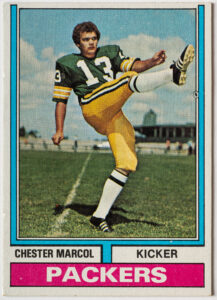 Every day is like Christmas for Chester Marcol, ’82.
He knows he is blessed to be alive. In fact, the 74-year-old Polish immigrant and former NFL placekicker is a living, breathing, walking miracle.
At times, his life has been a dream. The ability to kick a football accurately and with astonishing distance brought him to Hillsdale College, where he became a national media sensation. In 1969, he kicked what was then the longest field goal in college football history—a 62-yarder, which led to a successful NFL career with the Green Bay Packers.
For long stretches, his life has also been a nightmare. More than three decades of drug and alcohol abuse and addiction have taken a devastating toll, first on his football career, then his family, and finally his health. On the brink of death multiple times, he even tried taking his own life, but fortunately, as he now jokes, “God wasn’t ready for me yet.”
However, he has turned his curse of addiction into a blessing for many others dealing with the same demons. Now employed as an addiction counselor in the northernmost reaches of Michigan’s Upper Peninsula, he helps others with addiction. Marcol views work as his life’s purpose, and his reason to live.
During Marcol’s many, many years of wandering in the addiction desert, there was the oasis of Hillsdale College, which has been there for him in so many ways. After more than 40 years away from campus, Marcol recently returned to his alma mater to share his story: one of success, of failure, and of his never-ending quest for redemption.
Humble Beginnings
He was born Czesław Bolesław Marcol, the oldest of four children in the small farming town of Opole, Poland. In those days, life was simple: attend school, help with chores, and play the national pastime—soccer—as a standout goalkeeper known for his powerful kick.
Life changed drastically when he was 14 years old. His father took his own life, which sent shock waves through the entire family. With Poland firmly behind the Iron Curtain of communism, his mother made the decision to follow some of her family, who years earlier emigrated to the United States after World War II. In 1965, the Marcol family joined their relatives in Imlay City, Michigan, a farming community about an hour north of Detroit. With a new Americanized first name of “Chester,” the 15-year-old enrolled in the local high school, not speaking a word of English.
However, the universal language of sports translated well for Marcol, especially in gym class. Gym teacher and Hillsdale College graduate John Rowan, ’65, was playing goaltender during a soccer class, and he asked Marcol to kick the volleyball-turned-soccer ball toward the makeshift goal. Marcol obliged, and the ball rocketed by Rowan’s head and ricocheted off the gym wall and into his face, bloodying Rowan’s nose.
Rowan immediately had an idea: Let’s see what Marcol could do kicking a football. The coaches took him to the football field and asked him to kick a football between the goalposts. He obliged. From 30 yards out. Then 40. Even 50. All easily sailed through the uprights. The coaches were giddy and asked Marcol if he wanted to play football.
“I’m not going to play that barbaric sport,” said Marcol of his initial response. “No way.”
He was eventually persuaded and quickly became a force on the gridiron for Imlay City.
A Star Is Born
Marcol wasn’t just kicking and punting. He also played wide receiver and defensive back, using his blazing speed to make plays all over the field. But his powerful right leg was what college football coaches noticed the most.
Michigan State University was very interested in Marcol’s kicking talents; however, his limited knowledge of the English language was a major deterrent. Rowan contacted then-Hillsdale football coach Frank “Muddy” Waters about his star kicker.
“I didn’t even know what Hillsdale was or where it was,” Marcol said.
Rowan helped him find the way, and on his visit Marcol forged a quick bond with Waters, who convinced the curly haired soccer-style kicker to enroll at Hillsdale as an international student. Taking English as a Second Language coursework, he started classes in the fall of 1968.
“When I came to Hillsdale, I knew it’s where I belonged,” he said. “People just cared about people.”
Settling in Galloway Hall, Marcol lived with other international students who helped him transition to college life.
“It was nice because most of my friends were from South America,” said Marcol, who also joined the Delta Sigma Phi fraternity. “I fit in really well with people from different countries. And I really appreciated those friendships.”
Waters knew what he had in Marcol: a potential game-changing weapon. In fact, he told many of his assistant coaches that his freshman kicker would one day play in the NFL. However, Marcol was initially not happy with his coach’s plan for him to be a kicker, and only a kicker.
“I was as mad as a hornet,” Marcol said when he found out he was only going to be kicking and punting at Hillsdale. “I had never been on the second team on anything in high school. [Waters] said, ‘You have a talent that I haven’t seen before. You have something special, and you’re going to play in the NFL.’ People also told me that in high school.”
As a sophomore in 1969, Marcol announced his arrival to the college football scene. The highlight was making a 62-yard field goal, which at the time was a college and professional record. He was routinely making 40- and 50-yard attempts, and also averaged 48 yards a punt, which is still a Hillsdale record.
“I can make those, no problem,” Marcol said of making field goals at distance. “And I didn’t mean to be cocky. I knew I could do it. What a gift.”
By his senior year, Marcol was garnering a lot of attention from the media and NFL. The All-American drew a crowd every time he kicked, and Sports Illustrated even sent a writer to campus to profile Hillsdale’s wunderkind. That article appeared in the December 9, 1971, issue.
Despite all the personal accomplishments, including a record 104 consecutive made extra points, Marcol said his highlights as a Charger were team-based. He remembers Hillsdale making the NAIA playoffs during his sophomore season and traveling to Marquette, Michigan, to take on powerhouse Northern Michigan, which was a 40-plus-point favorite. The Chargers upset the Wildcats 10-7 that day with the aid of a Marcol field goal. It also was Waters’ 100th career victory, and the team celebrated after the game by jumping into the hotel pool, uniform, pads, and all.
“That’s a good memory,” Marcol said.
The Way to Green Bay
Marcol just knew he was going to be a Dallas Cowboy. When NFL scouts invaded the Hillsdale campus in the fall of 1971, he heard the most from Cowboys scouts. However, when the NFL Draft occurred in the spring of 1972, Marcol was sitting in his living room when the phone rang. It was a Green Bay Packers’ representative who informed him the Packers drafted him in the second round.
“The last place I ever wanted to play was in Green Bay,” Marcol said. “When I was at Hillsdale, we played St. Norbert College, which is 10 miles from Green Bay,” Marcol said. “It was the coldest game I have ever performed in. It was the coldest game I have ever performed in. It was so cold the day before the game, Muddy wouldn’t let us practice because he was worried that we would get frostbite. So, I ended up in Green Bay.”
In the history of the NFL, only six placekickers have been drafted higher than Marcol, who quickly learned what it meant to be a professional athlete. Waters, who by now was a father figure to Marcol, served as his agent. The negotiations went this way: The Packers offered a three-year contract, and Waters and Marcol accepted. His first-year salary was $18,000, and the deal did not include performance incentives that are now commonplace.
“It was a one-way street,” he said of the contract process. “If I played today, I’d be backing up a Brinks truck.”
Marcol turned out to be a bargain for the Packers, who were in desperate need of a kicker. He led the league in scoring with 128 points, and was named the NFC Rookie of the Year and first team All-Pro. He was a sensation to Packers fans, who called him the “Polish Prince” and the “Polish Messiah.”
He said his rookie highlight was kicking the game-winning field goal on Monday Night Football against the Detroit Lions at Tiger Stadium, where he had watched the Tigers play many times as a child. He is most proud that he never had a kickoff returned for a touchdown–high school, college, or pro.
Marcol again led the NFL in scoring in 1974, which earned him his second All-Pro honor. He was one of the game’s top kickers and remained so through much of the 1970s.
The Beginning of the End
Marcol’s autobiography, Alive and Kicking, published in 2012, provides a detailed, unvarnished account of his descent into addiction that eventually ended his NFL career and had destructive effects on his family and health.
Although Marcol was a social drinker during his college days—football players were forbidden to drink during the season or were at risk of losing their scholarship—there were no such rules in the NFL. Drinking and smoking were commonplace, and Marcol often partook with many of his teammates. However, when he tore his right leg quadricep during the season opener in 1975, he discovered something he called “magic.”
A trainer gave him some pain pills to mask the injury, and it did such a good job, he didn’t want the feeling to end.
“The first two painkillers I took were like candy,” he said. “Nobody prescribed it, and 20 minutes later, we’re playing cards, and I said to my buddies, ‘I want to feel this way for the rest of my life.’”
And he certainly tried. A combination of alcohol and painkillers quickly became his daily routine. When someone introduced him to a new drug—cocaine—Marcol was instantly hooked. In 1980, his last season in the NFL, the combination of drugs and injuries had diminished Marcol’s abilities to the point where the Packers released him.
“All of a sudden my career was over, and I didn’t know who I was,” Marcol said.
After a brief stint with the Houston Oilers, he had kicked his last football in the NFL. But his path to addiction was just beginning.
Help from Hillsdale
After his playing days—and his first marriage—were over, he spiraled into addiction and had no job prospects. One day, he got a call from then-Hillsdale Athletic Director Jack McAvoy, who knew Marcol was struggling.
“He really cared,” Marcol said. “He was part of our coaches who were always like that.”
McAvoy offered Marcol an opportunity to come back to campus to complete his degree, and the College would take care of his tuition. So, at age 31, Marcol returned to Hillsdale to complete his degree as he tried to get his life in order.
“I had a ball,” Marcol said of his return to Hillsdale. “I’m 31, and I’m moving into Galloway with all these 19-year-olds after 10 years in the NFL.”
He said going to class and working at a local group home kept him on a good path for a time. Marcol finished his degree in 1982, and although at the time he didn’t think his degree would matter, it eventually helped save his life.
From Bad to Worse
After leaving Hillsdale, Marcol bounced around the state of Michigan for the next few years, and his addiction troubles worsened. Perhaps the lowest point came in 1986, when Marcol tried to end his life. Despite drinking a cocktail of battery acid, rat poison, and vodka, his attempt failed. However, he severely damaged his esophagus and stomach and was even declared dead on his way to the hospital before being revived.
Again, Hillsdale was there for him. This time, Waters visited him in the hospital’s intensive care unit and spent weeks there. While Marcol was recovering from his life-threatening injuries, Waters was petitioning the NFL to help with his medical bills as well as helping him apply for Social Security disability benefits. He has a modest NFL pension, partly thanks to Waters’ efforts.
“Muddy was helpful beyond any expectations I would have from any coach,” he said.
Miraculously, Marcol walked out of the hospital in a few weeks and was able to resume his life. But that life included a cycle of addiction that lasted nearly 20 more years.
“I felt lower than whale crap at the bottom of the ocean,” Marcol said at the lowest point of his addiction. “That was my self-worth. I had none. I went from the penthouse to the crap house in no time.”
The ‘Cold’ Road to Recovery
After receiving treatment more than 20 times for his addictions, he finally was able to beat those demons. Marcol always believed in God, but it was when he trusted Him to take over his life that his recovery finally took hold. In 2007, he completed his last treatment, but by no means considers himself cured. He remains in a constant state of recovery.
“That phrase ‘one day at a time,’ or ‘one game at a time,’ I used to think that was so stupid,” Marcol said. “But that’s a fact. You know, I have a daily reprieve contingent on my spiritual wellness.”
He has turned his addiction demons into becoming others’ guardian angel. Marcol finally used his Hillsdale degree in health and physical education, accepting a position as an addiction counselor with the Phoenix House, a non-profit treatment center located in Calumet, Michigan, in the far reaches of the western Upper Peninsula. Marcol dislikes the wintry weather, but he said the Phoenix House gives him purpose and continues to save his life. Although he is long past retirement age, Marcol continues to work four days a week. He said his life depends on it.
“I don’t work. I have a passion for this work,” Marcol said. “I will retire when my Maker retires me.”
His NFL notoriety and his addiction past give him credibility with his clients. However, Marcol knows the odds are that most addicts will never recover, meaning his job is often a daunting task.
“My responsibility is to pass that on to other people and plant a seed of hope,” Marcol said of his work with his clients.
He can’t save most, but he has helped some. And he has made peace with that.
“I have many friends who [were] 20 years [sober] and are no longer here [alive] because they decided to drink or use drugs again,” he said. “My hope for all my patients is that the road they take from the treatment will be a different road from what they come in on. If you go back on the same road you come in on, the chances of recovery are nonexistent.”
Still Alive and Kicking
Remarkably, Marcol is still able to get around, although the years of addiction have taken a toll. His chest is a “road atlas” of surgery scars, and a defibrillator keeps his heartbeat steady. His eyesight is failing and there are fewer teeth from his college days. But his trademark warm, wide smile is still there.
As a member of the Packers Hall of Fame, he is invited back regularly for the team’s Alumni Day. Marcol compares the Green Bay community to Hillsdale and still has strong loyalties to the Packers and its fans.
An avid hunter and fisherman, Marcol is content with living a simple life in the U.P. His work with the Phoenix House keeps him going, as well as his love for his children. His 94-year-old mom still walks a mile a day, and he visits her from time to time. He knows the pain and suffering he has inflicted on his family and friends, not to mention himself, but is making amends the best way he can: helping others beat addiction.
“I’m just grateful for small gifts,” Marcol said. “I have always been a real simple guy from Poland.”
Tears flow when he talks about his former college coach and mentor. He said he often dreams of Hillsdale College and was grateful to visit campus for the first time in decades.
“Walking around today was a privilege, like a dream come true,” he said of his visit. “What a special place.”
On his campus tour, Marcol wanted to see “The Clock,” also known as Central Hall, which is one of his favorite places. As he straddled the 50-yard line of Frank “Muddy” Waters Stadium’s field, he squinted at the bright yellow goalposts to the north and smiled.
“It doesn’t look that far,” he said, pondering reliving his glory days one more time. But reality quickly sets in. “I may be a little crazy, but I’m not stupid.”

Doug Goodnough, ’90, is Hillsdale’s senior director of Alumni Marketing. He enjoys connecting with fellow alumni in new and wonderful ways.
Reposted from the fall 2024 issue of Arete.