
Polling Pioneer: Roy Wetzel, ’56, Revolutionized NBC News’ Election Coverage
Written by Doug Goodnough
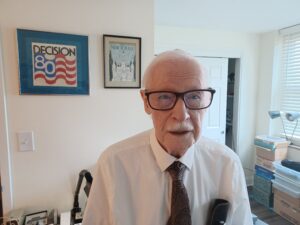
 Roy Wetzel, ’56, may have retired from NBC News more than 37 years ago, but his passion for broadcasting and politics remains. In fact, his Ann Arbor-area apartment looks more like a newsroom, complete with TV monitors, computer, printer, and charts.
He is currently analyzing data from the 2024 election, as well as data from the 35 U.S. Senate races that will occur in the 2026 midterms.
“Well, I’m not actually polling,” he clarified. “I’m reading other people’s polls. I evaluate the current races, and I will continue to update this.”
The 90-year-old who has worked with television news legends such as John Chancellor, David Brinkley, and Tom Brokaw began his career in broadcast news as a student at Hillsdale College. After being recruited by former Admissions Director Harriet Hale, he enrolled at Hillsdale in 1952, coming from the small town of Pleasant Ridge north of Detroit.
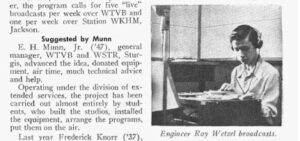
In high school, Wetzel was introduced to audio tape recorders, which was new technology at the time. He taught himself how to edit audio tapes and quickly developed an interest in radio. During his freshman year at Hillsdale, he and one of his Alpha Tau Omega fraternity brothers, Jim Lewis, ’55, began a radio studio on campus in the basement of the former Worthing Hall.
“There was one room occupied by the yearbook staff, and another room next to it occupied by the newspaper,” he recalled. “But there were a couple of empty rooms, and we turned one of those rooms into a control room and the larger one into a studio.”
Helped by Hal Munn, ’47, who owned and operated a radio station in nearby Coldwater, Michigan, Wetzel would record programs on campus and then drive the tapes to the station to be played over the air.
“Once a week, we would drive a batch of them over, because he broadcasted them every afternoon,” Wetzel said.
Munn visited campus at the start of Wetzel’s sophomore year and came up with a better idea.
“He climbed up to the attic of Worthing Hall and took a look west and saw that there was nothing but farms between him and his tower,” Wetzel said of Munn. “So he installed a very high-frequency transmitter up there so that we no longer had to make that half-hour drive. We could now be wired down to our little studio in the basement.”
After getting an FCC license to operate the high-frequency transmitter, Wetzel sent their programs directly to Munn’s station. He said that experience really was a springboard to his future career.
“I was the chief engineer and the chief announcer,” Wetzel said of his radio studio role. “And we had pretty good luck in getting the faculty to agree to [the station].”
However, after two years at Hillsdale, he entered the U.S. Army, where he contracted polio and spent most of his active duty doing office work before being discharged 18 months later.
During his time recovering, he decided he really wanted to pursue broadcasting and enrolled at the University of Michigan, which had one of the better programs in the country. After completing his journalism degree, Wetzel started his career as a newsroom director at a television station in Rochester, New York. His general manager was trying to compete with the Gannett-owned newspapers in town and told Wetzel he wanted to increase the station’s political coverage.
“We just started covering everything that moved,” said Wetzel, who had a chance to follow former New York Gov. Nelson Rockefeller’s presidential campaign. “We started doing live broadcasts from city council. Any time a politician said anything or moved, we made sure we were there to cover it. That was unusual at the time, almost unprecedented.”
That experience landed him a job in the broadcast news division of Washington Post Newsweek in Washington, D.C., where he got his introduction to national politics. He was eventually hired by NBC News. His first day on the job with NBC was President Richard Nixon’s inauguration on January 20, 1969. As a deputy manager for the Washington bureau, he worked for the radio news operation.
However, his stay in D.C. lasted less than a year, and Wetzel accepted a role as deputy bureau chief at NBC News in Chicago. In 1971 he was named bureau chief and news director of NBC’s affiliate in Cleveland, Ohio, and remained there until 1974.
When President Nixon resigned in August of 1974 due to the Watergate scandal, Wetzel was moved to New York City to observe NBC’s election unit.
“I was supposed to be an observer before taking it over at the end of the year,” he said. “Before two or three months, they were so overwhelmed that they had me assembling all of the coverage for the House of Representatives. The Senate and the House were both blazing stories that year.”
 Eventually, Wetzel took over NBC’s entire election coverage, and his first presidential election was Jimmy Carter versus Gerald Ford in 1976. He said he focused on the Democratic primary in Iowa and helped make Carter a national figure.
“I turned it into a national story. We did a national broadcast that night. It was the first time that had been a national thing, just because I was precocious and insisted on going out there and turning it into a story,” he said. “Some people might say I gave Jimmy Carter a much bigger boost than he deserved. But I didn’t give a damn about that. What I gave a damn about was making a big, national story.”
At the time there was not anything known as exit polling. However, Wetzel heard that news organizations like ITN in Great Britain were doing something similar in their election coverage. He was intrigued.
“I went over there, and I got a chance to go on one of their election days,” he said. “I went several times and got very friendly with the people who were running the [ITN] news. They said, ‘We’re going to have an election in Wales; why don’t you come along and watch?’ So I did. I took a fast train out from London in the morning and went around Wales and watched how they did it. And I realized quickly that although they were really onto something, their methodology wasn’t going to work for us. But I loved the idea and how they were doing it. So I changed it when I came back. Instead of going to 12 or 15 locations, we went to 1,500 locations all over the United States.”
Using his newfound exit polling data strategy, he said out of the 1,300 or so elections over 13 years, NBC made a total of six mistakes in calling a winner.
“And I was pretty proud of that,” said Wetzel, who made the final call on each and every one. “I hated every single one we called wrong. I felt like I’d gotten hit across the chest with a two by four when I realized that we were [wrong].”
He retired in 1988 after the George H.W. Bush vs. Michael Dukakis presidential election.
“I had done everything I was going to do,” he said of his decision to retire. “There was no sentimentality about it.”
Wetzel and his wife, Joanne, met during their time at the University of Michigan. He said they enjoyed living in urban cities such as New York, where they were season ticket holders for the Philharmonic for many years. They moved back to Ann Arbor in 1993, where they continued to relish the music scene until her passing in 2024.
How serious was Wetzel about his profession as a journalist? To maintain his objectivity, he has not voted in a presidential election since 1964. He said he “regrets” the current state of television news.
“When I see that there’s a large part of the population that prefers to get its news through a conservative filter, and there’s another big chunk of the population that prefers to get its news through a liberal filter, I really, truly regret that,” Wetzel said. “I think people would be better off if that weren’t the case.”
Although Wetzel didn’t complete his degree at Hillsdale, he has warm memories of his time on campus.
“Hillsdale in 1952, and ’53, and ’54—those were the glory days for me,” he said. “And there was hardly anybody on campus in 1952 who gave a hoot about national politics.”
Banner image courtesy of Pexels.
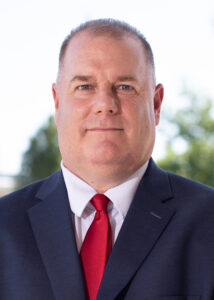
Doug Goodnough, ’90, is Hillsdale’s senior director of Alumni Marketing. He enjoys connecting with fellow alumni in new and wonderful ways.
Published in November 2025