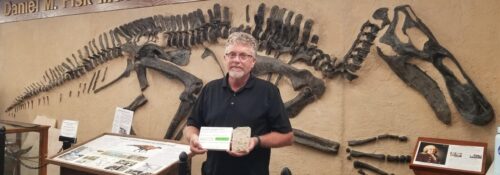
Hillsdale College Biology Professor Anthony Swinehart Discovers New Fossil Species
The new species of macroalga was named in Swinehart’s honor, and the fossil is housed in Hillsdale’s D. M. Fisk Museum of Natural History.
HILLSDALE, Mich. — Hillsdale College faculty member Anthony Swinehart, professor of biology, discovered a new species of fossil macroalga, which has been named in his honor. The fossil is now housed in Hillsdale’s D. M. Fisk Museum of Natural History. The species, named Earltonella swinehartii, is extinct, although it has some similarities to living seaweeds.
“This specimen is special because it is an alga that lacked hard parts, and soft parts, whether you’re talking about animals or plants, are rarely preserved — maybe you’ll get an impression,” Swinehart said. “But this fossil actually still had carbon residue on it. That’s what gives it the brown stained color. It’s decayed down to its basic carbon, but it’s only in very special sedimentary environments that this actually happens.”
“This specimen is special because it is an alga that lacked hard parts, and soft parts, whether you’re talking about animals or plants, are rarely preserved.”
Swinehart discovered the specimen while searching for fossils in a quarry in the Upper Peninsula with his research colleague Steve LoDuca, a professor of paleontology, sedimentology and stratigraphy at Eastern Michigan University. LoDuca, an expert in fossil algae, took the lead in describing the new species and named it in honor of Swinehart.
According to the Journal of Paleontology article announcing the discovery, E. swinehartii is an extinct species of macroalga, or seaweed. It is similar to a common kind of living seaweed called Caulerpa, which includes the invasive “killer algae” causing trouble in the Mediterranean Sea ecosystem. According to the article, the new species will help scientists understand the evolution of seaweeds.
The specimen Swinehart discovered is now housed in Hillsdale’s D. M. Fisk Museum of Natural History. It serves as the holotype for E. swinehartii — the primary specimen referenced by the person describing a new species. It is the first type specimen in the Fisk Museum.
Swinehart serves as the curator for the museum, which was first established in 1874 by Professor Daniel Moses Fisk. The museum contains thousands of biological, geological, and archaeological specimens, providing a point of discovery for visitors to the College, instructional material for Hillsdale College courses, and research specimens for Hillsdale College and the greater scientific community.