Hillsdale College Holds Seminar on International Relations
The seminar explored the purpose of U.S. foreign policy in the contexts of the Constitution and current issues.
HILLSDALE, Mich. — Hillsdale College hosted its first Center for Constructive Alternatives seminar of the 2025-26 academic year Sept. 7-10. The seminar, titled “Issues in International Relations,” explored the purpose of U.S. foreign policy in the context of the Constitution and of current issues in international relations.
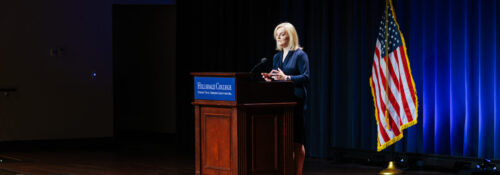
Liz Truss, former prime minister of the United Kingdom, spoke on “The U.S. and the U.K.: The Standing of the Special Relationship.”
“Unless we fight back, the West is going to be swallowed by the blob.”
“Every single country where somebody is trying to challenge the globalist worldview, there is a huge pushback, using not genuine debate but using unfair means — lawfare, bans, media briefings — to try and undermine them,” Truss said. “The fact is, those of us who are on the right, we’re fighting in a rigged system, and the left is now the well-connected establishment network in the West. And I believe that this network, this blob, this deep state, is a direct threat to our way of life and the ideas that made our countries great — Christian values, free speech, the nation state — and unless we fight back, the West is going to be swallowed by the blob.”
Christopher Caldwell of the Claremont Institute spoke on “Russian-Western European Relations.”
“I think that one of the reasons Europeans are clinging to Ukraine is that they’ve developed this system of permanent emergency law through the EU that is now no longer credible, that basically the Ukraine War is serving them as a fallback all-purpose emergency, and that once this war ends, these politicians will be left alone in a room with their high crime rates and their big deficits and their immigration problems and a lot of angry voters,” Caldwell said.
Brian T. Kennedy of the American Strategy Group spoke on “China’s Belt and Road Initiative.”
“I know very smart political analysts who believe that the Chinese dominance of the world is inevitable, and communist China spends $16 billion annually in the United States on intelligence and influence operations to make it seem like they are the inevitable superpower of the world,” Kennedy said. “Quantity may have a quality all its own, but in the contest between the communist slave and the free man, my money is still on the free man — the American who can figure out with his common sense what it will take to preserve our liberty. That’s the task before us.”
Other topics included “Foreign Policy and the Constitution,” “How to Think About U.S. Foreign Aid,” and “Critical Misunderstandings of the Middle East,” with speakers including Casey Wheatland of New College of Florida, Max Primorac of the Heritage Foundation, and Martin Kramer of Tel Aviv University.