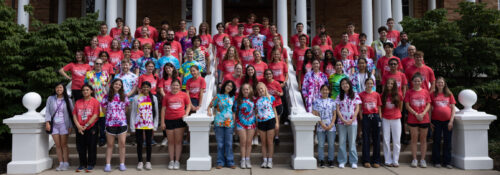
Hillsdale College Hosts Summer Science Camps for High Schoolers
Hillsdale College hosted summer camps for biology, chemistry and biochemistry, mathematics, and physics.
HILLSDALE, Mich. — Hillsdale College hosted summer science camps in biology, chemistry and biochemistry, mathematics, and physics. High school students from the community as well as nationwide had the opportunity to learn from Hillsdale College professors with the option of earning college credit.
“Our summer science camps give students lots of hands-on lab experiences to embellish their high school science education and to give them a taste of Hillsdale College,” said Matthew Young, dean of the natural sciences. “They also heard two plenary lectures from Hillsdale professors and had an ice cream social and other fun activities. The campers work hard, and they have a lot of fun together.”
“Our summer science camps give students lots of hands-on lab experiences to embellish their high school science education and to give them a taste of Hillsdale College.”
Biology camp explored DNA and photosynthesis. Campers studied photosynthesis using field and laboratory methods like colorimetry, light quantification, population sampling, protein extraction, and gel electrophoresis. Their hands-on study of DNA involved DNA isolation, polymerase chain reaction, DNA sequencing, and DNA fragment analysis.
Chemistry and biochemistry camp emphasized a hands-on laboratory experience in nanotechnology, organic synthesis, chemical dyes, polymers, chromatography, and chemical identification. Students also produced and purified proteins and studied the effects of mutation. Techniques involved included polymerase chain reaction, recombinant protein expression and purification, and fluorescence spectroscopy.
Mathematics camp explored the topics of group theory and topology using puzzles, hands-on activities, and group projects. Group theory describes symmetries and explains the patterns used to make and break codes. Topology — or “rubber-sheet geometry” — studies geometric properties that don’t change with stretching, shrinking, twisting and bending.
Physics camp explored multiple areas of physics through hands-on labs, demonstrations, activities and discussions. Topics included mechanics, electromagnetism, quantum mechanics, relativity, and optics.
Each camp included lectures, labs, and an examination for optional one-hour college credit.
Hillsdale College offers majors in biology, chemistry, biochemistry, and physics, as well as mathematics. Labs are taught by professors, not teaching assistants, and students have access to equipment often only available in graduate programs. Students work with faculty members on research and have the opportunity to be published as undergraduates. Required research, maximized lab time, small classes, and an interdisciplinary foundation prepare students for graduate work, teaching, and work in various scientific fields.