Hillsdale College Hosts Conference on the Vietnam War
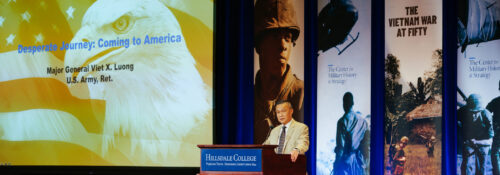
The Center for Military History and Strategy’s annual conference discussed ‘The Vietnam War at Fifty.’
HILLSDALE, Mich. — Hillsdale College’s Center for Military History and Strategy hosted its fourth annual conference, “The Vietnam War at Fifty,” Sept. 12-13.
Mark Moyar, William P. Harris Chair in Military History at Hillsdale College, spoke on “The History of the Vietnam War.” He argued that America entered the war partly on the belief that other nations in the region would fall unless the United States intervened in Vietnam.
“While Vietnam falls, most of the countries in the region that we cared about did not fall, and Vietnam had a lot to do with it,” Moyar said. “If we just bailed out of Vietnam, we wouldn’t probably even be competing for these countries. Instead, we have very robust allies who were helping us counter China, our biggest adversary.”
Hillsdale College President Larry P. Arnn gave remarks over dinner, and Bing West, former assistant secretary of defense for international security affairs and author of “The Village,” spoke on “The Strategic Legacies of the Vietnam War.”
The next morning Viet Luong, United States Army major general, ret., spoke on “The South Vietnamese Exodus,” highlighting the stories and contributions of people, including his family, who fled to America from South Vietnam.
“Our success is predicated on many things — obviously family values, our faith, hard work, resilience,” Luong said. “But I can simply say that none of this would’ve happened if we weren’t Americans. We feel a deep sense of loyalty and love for this country. We are deeply patriotic.”
A Hillsdale College faculty roundtable followed, and Victor Davis Hanson, Wayne and Marcia Buske Distinguished Fellow in History, spoke on “The Political and Cultural Legacies of the Vietnam War,” arguing that the war had lasting negative effects on America’s culture.
“You could make the argument that the Civil War radically changed the United States for the better with the elimination of slavery and the regrouping of the union. You could make the argument that World War I, the United States came out as the premier world power following the war, the financial juggernaut of the world. You can say World War II, by 1945, all of the enemies of the United States were vanquished,” Hanson said. “And culturally, we were dominant after all three of those wars. After Vietnam, we left enormous wounds on the United States, and we didn’t feel that way. Our economy was altered, our major institutions were altered, and I don’t think they’ve completely recovered.”
- Photos from the conference
- Photos of Hillsdale College
- High-resolution copy of the Hillsdale College clocktower logo
About the Center for Military History and Strategy
The Center for Military History and Strategy (CMHS) studies warfare from all times and places to better our comprehension and military readiness. Its focus lies in academic research that joins military history with insights from strategic thinkers throughout history. By providing an education in the study of war and strategy, the CMHS strives to prepare scholars, officers, and policymakers to preserve those “inestimable blessings” of liberty in a world that continues to ignore the lessons of the past. For more information, visit warhistory.hillsdale.edu.
###