Hillsdale College’s Blake Center for Faith and Freedom Hosts Talk on C.S. Lewis
Distinguished Visiting Fellow Michael Ward spoke on C.S. Lewis’s ‘Mere Christianity.’
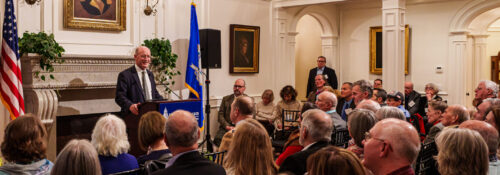
HILLSDALE, Mich. — Hillsdale College’s Blake Center for Faith and Freedom hosted Distinguished Visiting Fellow Michael Ward on April 11 for a lecture on C.S. Lewis’s “Mere Christianity.”
“At the Blake Center, we seek to affirm the essentials of the Christian faith while engaging in the dialogue fostered by religious liberty,” said Alan Crippen, executive director and chaplain of the Blake Center. “In ‘Mere Christianity,’ C.S. Lewis focuses on the things that all Christians have generally believed, encouraging unity amid differences in doctrine and practice. It was an honor to host Michael Ward for a discussion of this important work of Christian apologetics.”
“He ignores out of existence those things that separate different Christian traditions, or rather he relativizes them by capturing them in this household image.”
Ward said that Lewis’s low-church Anglican upbringing in a part of Ireland deeply divided between Catholic and Protestant influenced his ecumenical views.
“Having been born into and raised in one of the most divided Christian environments in the world, Lewis was well placed to observe the petty-mindedness and ignorance that so very often divided Christian from Christian — and entirely unnecessarily much of the time,” Ward said.
According to Ward, “Mere Christianity” began as a series of broadcast lectures, which Lewis made into three short books and then eventually into the single book that became his most influential work of apologetics. Ward said that in “Mere Christianity” Lewis uses the image of a house of Christianity with denominational rooms branching off a hallway. According to Ward, Lewis sought to bring people from outside the house into the hallway, with little concern for which room they chose.
“He ignores out of existence those things that separate different Christian traditions, or rather he relativizes them by capturing them in this household image,” Ward said. “He’s not ushering people from their particular denominational rooms into a common area called reunion. He is instead asserting that different Christians already live in the same house. They’re already united in at least the basics.”
According to Ward, Lewis sought ecumenism not in doctrine but in charity — something he practiced in his own interactions with those from different traditions, most notably J.R.R. Tolkien, who was his close friend and a Roman Catholic.
“If Lewis had not become friends with Tolkien, then quite possibly Lewis would not have become an adult Christian, or at least not at this pivotal stage of his life in his early thirties with his whole writing career ahead of him,” Ward said. “And thus, we might not have had ‘Mere Christianity’ or ‘The Screwtape Letters’ or the Narnia books.”
Michael Ward is a distinguished visiting fellow in religion at Hillsdale College. He studied English at Oxford and theology at the University of Cambridge and received a Ph.D. in divinity from the University of St. Andrews. He is the author of several books, including “After Humanity: A Guide to C.S. Lewis’s ‘The Abolition of Man.’”
For photos from the event, click here. For photos of the Blake Center, click here. For a high-resolution copy of the Hillsdale College clocktower logo, click here.
About the Blake Center for Faith and Freedom
Philanthropists Prestley and Helen Blake donated the buildings and acreage of their estate in Somers, Connecticut, to Hillsdale College in 2019. The Blake Center for Faith and Freedom is a religious institution that includes, an exterior replica of Monticello, Thomas Jefferson’s renowned neo-classical home in Virginia. The College utilizes the property to host events that further its mission, focusing on the foundational principles of faith and freedom. To this end, most events held at the Blake Center have clear religious themes, focusing on topics relating to Christianity, man’s relationship to God, and faith generally.